
Blog
HOME / BLOG


The 7 Colors of the Rainbow: Order, Meaning, and Science Behind It
Rainbows are among the most beautiful sights in nature. After rainfall, when sunlight shines through tiny water droplets in the air, a colorful arc sometimes appears in the sky. This natural phenomenon is called a rainbow.
The colors in a rainbow are not random. They always appear in the same sequence and form a spectrum of visible light that our eyes can see. Understanding the colors of a rainbow and how they are formed helps us appreciate the science behind this amazing natural display.
What Are the Seven Colors of the Rainbow?
A rainbow is traditionally described as having seven colors. These colors appear in a fixed order from the outer edge to the inner arc of the rainbow.
The seven colors are:
-
Red
-
Orange
-
Yellow
-
Green
-
Blue
-
Indigo
-
Violet
A simple way to remember this order is through the mnemonic ROYGBIV.
-
R – Red
-
O – Orange
-
Y – Yellow
-
G – Green
-
B – Blue
-
I – Indigo
-
V – Violet
Many students use this short and easy trick to remember the sequence of rainbow colors.
Why Do Rainbows Form?
Rainbows appear when sunlight interacts with water droplets in the atmosphere. This usually happens after rain when sunlight passes through small droplets that remain in the air.
Three scientific processes occur during the formation of a rainbow.
1. Refraction
When sunlight enters a water droplet, the light slows down and bends. This bending of light is known as refraction.
2. Reflection
After entering the droplet, the light reflects off the inside surface of the droplet.
3. Dispersion
When the light exits the droplet, it spreads into different colors. This separation of white light into multiple colors is called dispersion.
These three processes together create the colorful arc that we see in the sky.
Who Identified the Seven Colors of the Rainbow?
The classification of the seven rainbow colors was popularized by Isaac Newton.
During his experiments with a glass prism, Newton discovered that white sunlight is actually made up of many colors. When light passes through a prism, it splits into a spectrum similar to a rainbow.
Although the spectrum contains many shades, Newton grouped them into seven main colors to make them easier to understand and study.
Wavelengths of Rainbow Colors
Each color in the rainbow has a different wavelength of light.
-
Red – Longest wavelength
-
Orange – Slightly shorter than red
-
Yellow – Medium wavelength
-
Green – Balanced wavelength
-
Blue – Shorter wavelength
-
Indigo – Between blue and violet
-
Violet – Shortest wavelength
These differences in wavelengths are the reason why colors separate when light is dispersed.
Is the Rainbow Really Made of Only Seven Colors?
Even though we usually say a rainbow has seven colors, the rainbow actually contains a continuous spectrum of light. This means the colors blend smoothly into one another, creating many additional shades.
However, the seven-color classification makes it easier for people, especially students, to learn and remember the order of the colors.
Interesting Facts About Rainbows
-
Rainbows always appear opposite the sun in the sky.
-
You cannot reach the end of a rainbow because it is an optical illusion created by light and water droplets.
-
Sometimes a double rainbow appears, where a faint second arc forms outside the main rainbow.
-
In a secondary rainbow, the order of colors is reversed.
Conclusion
Rainbows are not only beautiful natural sights but also a fascinating example of how light behaves in nature. The seven colors — Red, Orange, Yellow, Green, Blue, Indigo, and Violet — represent the visible spectrum created when sunlight passes through water droplets.
Learning about natural science topics like rainbows helps children develop curiosity and creativity. Many schools introduce these concepts through fun classroom activities and experiments. If you want your child to learn through engaging methods, explore programs offered by the best preschool in Noida that focus on activity-based learning.
Recent Post
 April 8, 2026
Drawing Activities for Kids: Creative Learning Ideas for Preschooler
 April 4, 2026
How to Teach Kids to Write Alphabets (Complete Step-by-Step Guide)
 April 3, 2026
Human Body Parts Name – Complete Guide (Head to Toe)
 March 31, 2026
National Symbols of India: Complete List with Meaning & Importance
 March 16, 2026
Height Weight Chart for Kids: A Complete Growth Guide for Parents
 March 9, 2026
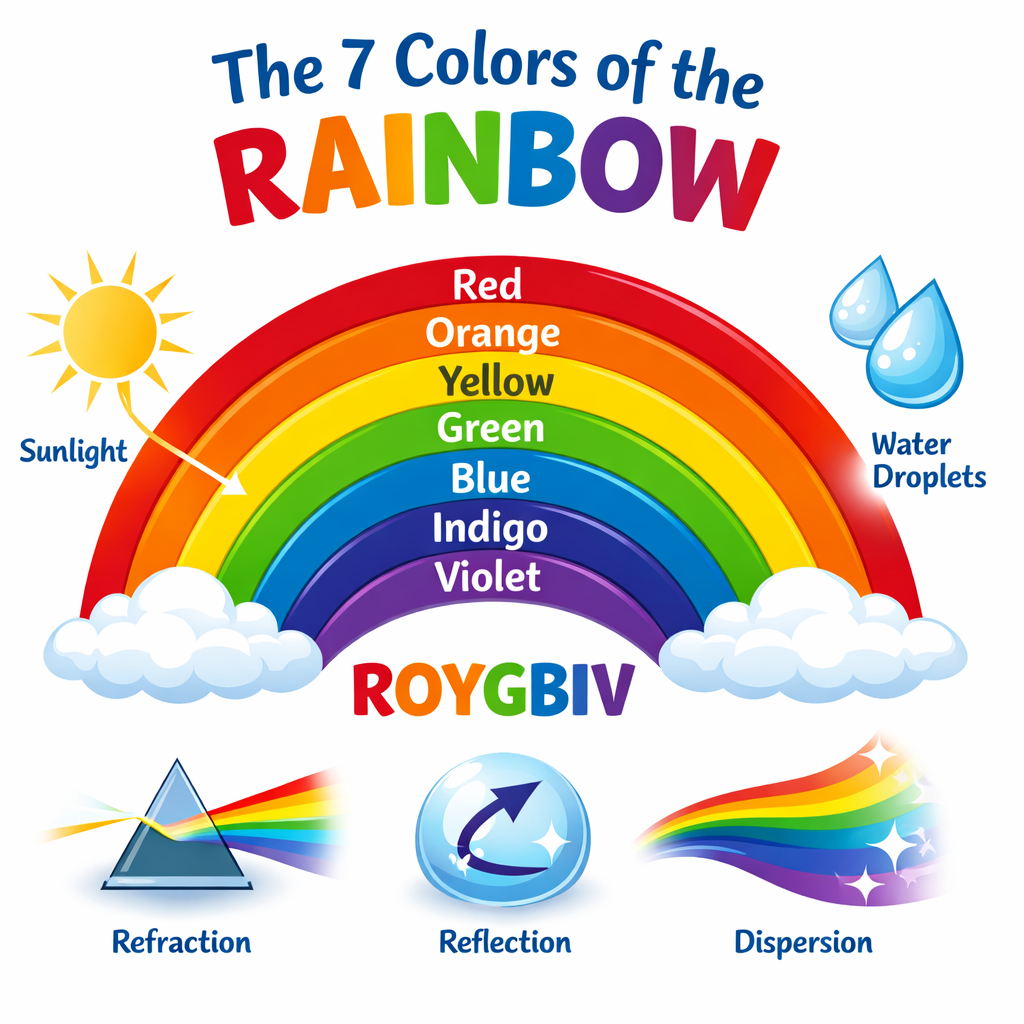
The 7 Colors of the Rainbow: Order, Meaning, and Science Behind It
 March 7, 2026
Fun learning activities for 0–4-year-olds kids
 March 6, 2026
Importance of Good Nutrition for Kids
 February 20, 2026
Beyond Babysitting: How Working Parents Can Identify a Daycare That Truly Builds Their Child’s Future
 February 19, 2026
10+ Preschool Activities That Make Learning Fun for Kids
 February 17, 2026
Holi Activities for Children/kids: Safe, Creative, and Sensory-Rich Celebration Ideas
 January 27, 2026
Best Preschool in Noida Sector 122 – What Parents Should Look For
January 27, 2026
Playgroup vs Nursery – Which Is Right for Your Child?
January 27, 2026
Preschool Admission Process in Noida – A Parent’s Guide (2026–27)
January 27, 2026
How Play-Based Learning Supports Early Childhood Development